Difference between revisions of "LEVENESTEST"
Jump to navigation
Jump to search
| Line 5: | Line 5: | ||
==='''DESCRIPTION'''=== | ==='''DESCRIPTION'''=== | ||
| − | a.'''This function used to test the Homogeneity of variances. | + | a. '''This function used to test the Homogeneity of variances. |
| − | b.'''Levene's test is used to test the Samples have equal variances. | + | b. '''Levene's test is used to test the Samples have equal variances. |
| − | c.'''Equal variances across samples is called homogeneity of variance or homoscedasticity. | + | c. '''Equal variances across samples is called homogeneity of variance or homoscedasticity. |
'''To perform the Levene's test we need the following assumptions: | '''To perform the Levene's test we need the following assumptions: | ||
1.'''''The Samples from the populations are independent of one another.''''' | 1.'''''The Samples from the populations are independent of one another.''''' | ||
Revision as of 14:42, 12 August 2020
LEVENESTEST(xRange, ConfidenceLevel, NewTableFlag)
- is the set of values for the test.
- is the value from 0 to 1.
- is either TRUE or FALSE. TRUE for getting results in a new cube. FALSE will display results in the same cube.
 is the set of values for the test.
 is the value from 0 to 1.
 is either TRUE or FALSE. TRUE for getting results in a new cube. FALSE will display results in the same cube.
DESCRIPTION
a. This function used to test the Homogeneity of variances. b. Levene's test is used to test the Samples have equal variances. c. Equal variances across samples is called homogeneity of variance or homoscedasticity. To perform the Levene's test we need the following assumptions:
1.The Samples from the populations are independent of one another.
2.The population under consideration are Normally Distributed.
For three or more variables the following statistical tests for homogeneity of variances are commonly used:
  a.Levene's Test.
  b.Bartlett Test.
- Levene's test is an alternative to the Bartlett test.
- If the data surely is of normally distributed or nearly to normally distributed then we can use the Bartlett test.
- The Levene's test is defined as
- .
- = Not all of the variances are equal.
 .
. = Not all of the variances are equal.
Normally there are three versions of the Levenes test. These are:
- Use of Mean.
- Use of Median.
- Use of 10% of Trimmed Mean.
The Levene test statistic is:
- .
 .
.- where is the result of the test.
- is the number of different groups to which the sampled cases belong.
- is the total number of cases in all groups.
- is the number of cases in the group.
- is the value of the measured variable for the case from the group.
 is the result of the test.
  is the number of different groups to which the sampled cases belong.
 is the total number of cases in all groups.
 is the number of cases in the
  group.
 is the value of the measured variable for the
  case from the
 Zij is satisfying the one of the following conditions:
- ,Where is the Mean of the subgroup.
- ,Where is the Median of the subgroup
- ,Where is the 10%Trimmed Mean of the subgroup.
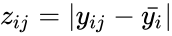 ,Where
  is the Mean of the
 Levene's Testing Procedure:
- checking the assumptions.
- State the Null(H0) and alternative(H1) hypothesis.
- Decide on the Significance level (α).
- Finding the Critical value and Rejection Region.Here ,Failed to parse (MathML with SVG or PNG fallback (recommended for modern browsers and accessibility tools): Invalid response ("Math extension cannot connect to Restbase.") from server "https://wikimedia.org/api/rest_v1/":): {\displaystyle df_2=N-t} .
- Compute the Levenes statistic using the formula.
- Then decision of the value of the test statistic,W is falls in the rejection region or if p-value ≤ α, then reject Failed to parse (MathML with SVG or PNG fallback (recommended for modern browsers and accessibility tools): Invalid response ("Math extension cannot connect to Restbase.") from server "https://wikimedia.org/api/rest_v1/":): {\displaystyle H_0} .Otherwise, fail to reject Failed to parse (MathML with SVG or PNG fallback (recommended for modern browsers and accessibility tools): Invalid response ("Math extension cannot connect to Restbase.") from server "https://wikimedia.org/api/rest_v1/":): {\displaystyle H_0} . For the computation p-value we have to use the value of Failed to parse (MathML with SVG or PNG fallback (recommended for modern browsers and accessibility tools): Invalid response ("Math extension cannot connect to Restbase.") from server "https://wikimedia.org/api/rest_v1/":): {\displaystyle df_1} and Failed to parse (MathML with SVG or PNG fallback (recommended for modern browsers and accessibility tools): Invalid response ("Math extension cannot connect to Restbase.") from server "https://wikimedia.org/api/rest_v1/":): {\displaystyle df_2}
- Finally we have to conclude that the rejection of Failed to parse (MathML with SVG or PNG fallback (recommended for modern browsers and accessibility tools): Invalid response ("Math extension cannot connect to Restbase.") from server "https://wikimedia.org/api/rest_v1/":): {\displaystyle H_0}
or fail to rejection Failed to parse (MathML with SVG or PNG fallback (recommended for modern browsers and accessibility tools): Invalid response ("Math extension cannot connect to Restbase.") from server "https://wikimedia.org/api/rest_v1/":): {\displaystyle H_0}
according to the test statistic at the significance level.
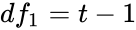 ,Failed to parse (MathML with SVG or PNG fallback (recommended for modern browsers and accessibility tools): Invalid response ("Math extension cannot connect to Restbase.") from server "https://wikimedia.org/api/rest_v1/":): {\displaystyle df_2=N-t}
.
,Failed to parse (MathML with SVG or PNG fallback (recommended for modern browsers and accessibility tools): Invalid response ("Math extension cannot connect to Restbase.") from server "https://wikimedia.org/api/rest_v1/":): {\displaystyle df_2=N-t}
.EXAMPLE
| X1 | X2 |
| 3067 | 3200 |
| 2730 | 2777 |
| 2840 | 2623 |
| 2913 | 3044 |
| 2789 | 2834 |
=LEVENESTEST(B1:C5, 0.05, 0)
| DATA-0 | DATA-1 | |
|---|---|---|
| Median | 2840 | 2834 |
| Mean | 2867.8 | 2895.6 |
| Variance | 16923.7 | 51713.3 |
| Count | 5 | 5 |
| df | 4 | 4 |
| LEVENESTEST | STATISTICS |
|---|---|
| W | 1.0439235110342522 |
| P-Value | 0.3368108674971864 |
| α | 0.05 |
| Result | Accept Null Hypothesis that variances are equal for all groups |
RELATED VIDEOS
SEE ALSO