Difference between revisions of "Durbin-Watson"
Jump to navigation
Jump to search
| (12 intermediate revisions by the same user not shown) | |||
| Line 1: | Line 1: | ||
| − | <div style="font-size:25px">'''DURBINWATSONTEST(DataRange,ConfidenceLevel,NewTableFlag)'''</div | + | <div style="font-size:25px">'''DURBINWATSONTEST(DataRange,ConfidenceLevel,NewTableFlag)'''</div> |
| − | *<math>DataRange</math> is the array of x and y values. | + | *'''<math>DataRange</math> is the array of x and y values. |
| − | *<math>ConfidenceLevel</math> is the value of alpha from 0 to 1. | + | *'''<math>ConfidenceLevel</math> is the value of alpha from 0 to 1. |
| − | *<math>NewTableFlag</math> is either TRUE or FALSE. TRUE for getting results in a new cube. FALSE will display results in the same cube | + | *'''<math>NewTableFlag</math> is either TRUE or FALSE. TRUE for getting results in a new cube. FALSE will display results in the same cube.<br></br> |
| − | == | + | ==='''DESCRIPTION=== |
| − | *This function gives the test statistic of the Durbin-Watson test. | + | *'''This function gives the test statistic of the Durbin-Watson test. |
| − | * The test is used to detect the presence of autocorrelation in the residuals. | + | *'''The test is used to detect the presence of autocorrelation in the residuals. |
| − | * Autocorrelation means that adjacent observations are correlated. | + | *'''Autocorrelation means that adjacent observations are correlated. |
| − | * If they are correlated, then least-squares regression underestimates the standard error of the coefficients. | + | *'''If they are correlated, then least-squares regression underestimates the standard error of the coefficients. |
| − | == | + | ==='''ASSUMPTIONS=== |
| − | The error terms are independent of each other. | + | '''The error terms are independent of each other. |
| − | *The Durbin-Watson test uses the following statistic: | + | *'''The Durbin-Watson test uses the following statistic: |
| − | <math>d=\frac{\sum_{i=2}^n (e_i-e_{i-1})^2)}{\sum_{i=1}^n (e_i)^2}</math> | + | :'''<math>d=\frac{\sum_{i=2}^n (e_i-e_{i-1})^2)}{\sum_{i=1}^n (e_i)^2}</math> |
| − | * where the <math>e_i = y_i-\bar{y_i}</math> are the residuals. | + | *'''where the <math>e_i = y_i-\bar{y_i}</math> are the residuals. |
| − | * n is the number of elements in the sample. | + | *'''n is the number of elements in the sample. |
| − | * k is the number of independent variables. | + | *'''k is the number of independent variables. |
| + | *'''d takes the values between 0 and 4. | ||
| + | * '''d = 2 means there is no autocorrelation. | ||
| + | * '''A value substantially below 2 means that the data is positively autocorrelated. | ||
| + | * '''A value of d substantially above 2 means that the data is negatively autocorrelated. | ||
| − | + | ==='''RESULT=== | |
| − | * | + | * '''if D > upper bound, no correlation exists. |
| − | * | + | * '''if D < lower bound, positive correlation exists. |
| − | * | + | * '''if D is in between the two bounds, the test is inconclusive. |
| − | == | + | ==='''EXAMPLE=== |
| − | |||
| − | |||
| − | |||
| − | |||
| − | |||
{| class="wikitable" | {| class="wikitable" | ||
|+Spreadsheet | |+Spreadsheet | ||
| Line 68: | Line 67: | ||
| 2 || 9 || 2 || 49 | | 2 || 9 || 2 || 49 | ||
|} | |} | ||
| − | + | ='''DURBINWATSONTEST([A1:A11, B1:B11, C1:C11, D1:D11], 0.05, true) | |
| + | |||
{| class="wikitable" | {| class="wikitable" | ||
|+DURBIN-WATSON TEST | |+DURBIN-WATSON TEST | ||
| Line 110: | Line 110: | ||
|} | |} | ||
| − | + | '''CONCLUSION:''' As, DL TABLE < D < DU TABLE, Test is inconclusive. | |
Latest revision as of 09:07, 19 August 2020
DURBINWATSONTEST(DataRange,ConfidenceLevel,NewTableFlag)
- is the array of x and y values.
- is the value of alpha from 0 to 1.
- is either TRUE or FALSE. TRUE for getting results in a new cube. FALSE will display results in the same cube.
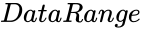 is the array of x and y values.
 is the value of alpha from 0 to 1.
 is either TRUE or FALSE. TRUE for getting results in a new cube. FALSE will display results in the same cube.
DESCRIPTION
- This function gives the test statistic of the Durbin-Watson test.
- The test is used to detect the presence of autocorrelation in the residuals.
- Autocorrelation means that adjacent observations are correlated.
- If they are correlated, then least-squares regression underestimates the standard error of the coefficients.
ASSUMPTIONS
The error terms are independent of each other.
- The Durbin-Watson test uses the following statistic:

- where the are the residuals.
- n is the number of elements in the sample.
- k is the number of independent variables.
- d takes the values between 0 and 4.
 are the residuals.
* d = 2 means there is no autocorrelation. * A value substantially below 2 means that the data is positively autocorrelated. * A value of d substantially above 2 means that the data is negatively autocorrelated.
RESULT
* if D > upper bound, no correlation exists.
* if D < lower bound, positive correlation exists.
* if D is in between the two bounds, the test is inconclusive.
EXAMPLE
| A | B | C | D | |
|---|---|---|---|---|
| 1 | 3 | 7 | 5 | 65 |
| 2 | 4 | 3 | 7 | 38 |
| 3 | 5 | 5 | 8 | 51 |
| 4 | 6 | 8 | 1 | 38 |
| 5 | 7 | 9 | 3 | 55 |
| 6 | 8 | 5 | 4 | 43 |
| 7 | 2 | 4 | 0 | 25 |
| 8 | 3 | 2 | 6 | 33 |
| 9 | 8 | 8 | 7 | 71 |
| 10 | 9 | 6 | 4 | 51 |
| 11 | 2 | 9 | 2 | 49 |
=DURBINWATSONTEST([A1:A11, B1:B11, C1:C11, D1:D11], 0.05, true)
| Y | PREDICTED Y | RESIDUAL |
|---|---|---|
| 65 | 54.11461 | 10.88539 |
| 38 | 42.54638 | -4.54638 |
| 51 | 56.06668 | -5.06668 |
| 38 | 44.9235 | -6.9235 |
| 55 | 57.33098 | -2.33098 |
| 43 | 42.08043 | 0.91957 |
| 25 | 21.06987 | 3.93013 |
| 33 | 33.82123 | -0.82123 |
| 71 | 67.51283 | 3.48717 |
| 51 | 47.12326 | 3.87674 |
| 49 | 52.41022 | -3.41022 |
| VARIABLE | RESULT |
|---|---|
| D | 1.37587 |
| DL TABLE | 0.595 |
| DU TABLE | 1.928 |
| RESULT | TEST IS INCONCLUSIVE |
CONCLUSION: As, DL TABLE < D < DU TABLE, Test is inconclusive.