Difference between revisions of "Durbin-Watson"
Jump to navigation
Jump to search
| Line 11: | Line 11: | ||
==Assumptions== | ==Assumptions== | ||
| − | + | The error terms are independent of each other. | |
*The Durbin-Watson test uses the following statistic: | *The Durbin-Watson test uses the following statistic: | ||
<math>d=\frac{\sum_{i=2}^n (e_i-e_{i-1})^2)}{\sum_{i=1}^n (e_i)^2}</math> | <math>d=\frac{\sum_{i=2}^n (e_i-e_{i-1})^2)}{\sum_{i=1}^n (e_i)^2}</math> | ||
| − | where the <math>e_i = y_i-\bar{y_i}</math> | + | * where the <math>e_i = y_i-\bar{y_i}</math> are the residuals |
| + | * n is the number of elements in the sample | ||
| + | * k is the number of independent variables | ||
Revision as of 05:48, 3 May 2017
DURBINWATSONTEST(DataRange,ConfidenceLevel,NewTableFlag))
- is the array of x and y values.
- is the value of alpha from 0 to 1.
- is either TRUE or FALSE. TRUE for getting results in a new cube. FALSE will display results in the same cube
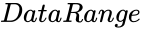 is the array of x and y values.
 is the value of alpha from 0 to 1.
 is either TRUE or FALSE. TRUE for getting results in a new cube. FALSE will display results in the same cube
Description
- This function gives the test statistic of the Durbin-Watson test.
- The test is used to detect the presence of autocorrelation in the residuals.
- Autocorrelation means that adjacent observations are correlated.
- If they are correlated, then least-squares regression underestimates the standard error of the coefficients.
Assumptions
The error terms are independent of each other.
- The Durbin-Watson test uses the following statistic:

- where the are the residuals
- n is the number of elements in the sample
- k is the number of independent variables
 are the residuals