Difference between revisions of "Bartlett'sTest"
Jump to navigation
Jump to search
| Line 17: | Line 17: | ||
==Example== | ==Example== | ||
| + | {| class="wikitable" | ||
| + | |+Spreadsheet | ||
| + | |- | ||
| + | ! !! A !! B !!C !!D | ||
| + | |- | ||
| + | ! 1 | ||
| + | | 51 || 87 || 50 || 48 || 79 || 61 || 53 || 54 | ||
| + | |- | ||
| + | ! 2 | ||
| + | | 82 || 91 || 92 || 80 || 52 || 79 || 73 || 74 | ||
| + | |- | ||
| + | !3 | ||
| + | | 79 || 84 || 74 || 98 || 63 || 83 || 85 || 58 | ||
| + | |- | ||
| + | !4 | ||
| + | | | ||
Revision as of 08:05, 9 May 2017
BARTLETTSTEST(DataRange,ConfidenceLevel,NewTableFlag)
- is the array of x values.
- is the value from 0 to 1.
- is either TRUE or FALSE. TRUE for getting results in a new cube. FALSE will display results in the same cube.
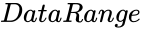 is the array of x values.
 is the value from 0 to 1.
 is either TRUE or FALSE. TRUE for getting results in a new cube. FALSE will display results in the same cube.
Description
- Bartlett's test is used to test if k samples are from populations with equal variances.
- Bartlett's test is sensitive to departures from normality.
- That is, if the samples come from non-normal distributions, then Bartlett's test may simply be testing for non-normality.
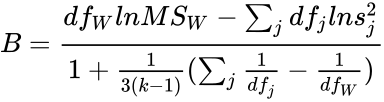
- B is the Bartlett's test static.
- is the pooled variance across all groups.
 is the pooled variance across all groups.
Result
- If p-value is greater than BCriticl value, reject the null hypothesis.
- Else retain null hypothesis.
Example
| A | B | C | D | |||||
|---|---|---|---|---|---|---|---|---|
| 1 | 51 | 87 | 50 | 48 | 79 | 61 | 53 | 54 |
| 2 | 82 | 91 | 92 | 80 | 52 | 79 | 73 | 74 |
| 3 | 79 | 84 | 74 | 98 | 63 | 83 | 85 | 58 |
| 4 |