Difference between revisions of "Manuals/calci/BASETHETA"
Jump to navigation
Jump to search
| (9 intermediate revisions by 2 users not shown) | |||
| Line 4: | Line 4: | ||
==Description== | ==Description== | ||
*This function shows the Base theta value. | *This function shows the Base theta value. | ||
| − | *The basic theta function is defined to be the function <math>\theta : \mathbb{C} | + | *The basic theta function is defined to be the function <math> \theta</math>:<math>\mathbb{C} \rarr \mathbb{C} </math> given by <math>\theta(z):= \theta(\tau)(z):=\sum_{n\in z} exp(\pi in^2 \tau)exp(2\pi inz)</math> |
| − | *The function <math>\theta</math> depends on <math>\tau</math> | + | *The function <math>\theta</math> depends on <math>\tau</math> . |
| − | *So for each <math>\tau \in \mathbb{C}</math> | + | *So for each <math>\tau \in \mathbb{C}</math> with <math>Im \tau > 0</math> we get a (not necessarily different) basic theta function. |
| − | *Hence there is a whole family of basic theta functions { | + | *Hence there is a whole family of basic theta functions <math>{\theta(\tau )},\tau \in \mathbb{C}</math>,Im <math>\tau > 0</math>. |
| − | *But here we assume | + | *But here we assume <math>\tau</math> to be fixed, so we have only one basic theta function. |
*The basic theta function is quasi-periodic. | *The basic theta function is quasi-periodic. | ||
*Base Theta is locally uniformly unordered convergent also basic theta function is an entire function. | *Base Theta is locally uniformly unordered convergent also basic theta function is an entire function. | ||
| + | |||
| + | ==Examples== | ||
| + | #BASETHETA(45) = 1.0177028497428964 | ||
| + | #BASETHETA(90) = 2.0354056994857928 | ||
| + | #BASETHETA(8640) = 0.6202026280698192 | ||
| + | |||
| + | ==Related Videos== | ||
| + | |||
| + | {{#ev:youtube|v=hTGhCGrPLmw|280|center|Trigonometric Angles}} | ||
| + | |||
| + | ==See Also== | ||
| + | *[[Manuals/calci/DEGREES | DEGREES]] | ||
| + | *[[Manuals/calci/RADIANS | RADIANS]] | ||
| + | *[[Manuals/calci/ANGLE | ANGLE]] | ||
| + | |||
| + | ==References== | ||
| + | [http://www.maths.tcd.ie/pub/ims/bull60/R6004.pdf Theta Functions] | ||
| + | |||
| + | |||
| + | |||
| + | *[[Z_API_Functions | List of Main Z Functions]] | ||
| + | |||
| + | *[[ Z3 | Z3 home ]] | ||
Latest revision as of 15:48, 10 December 2018
BASETHETA (Theta)
- Failed to parse (MathML with SVG or PNG fallback (recommended for modern browsers and accessibility tools): Invalid response ("Math extension cannot connect to Restbase.") from server "https://wikimedia.org/api/rest_v1/":): {\displaystyle Theta } is the angle value.
Description
- This function shows the Base theta value.
- The basic theta function is defined to be the function Failed to parse (MathML with SVG or PNG fallback (recommended for modern browsers and accessibility tools): Invalid response ("Math extension cannot connect to Restbase.") from server "https://wikimedia.org/api/rest_v1/":): {\displaystyle \theta} :Failed to parse (MathML with SVG or PNG fallback (recommended for modern browsers and accessibility tools): Invalid response ("Math extension cannot connect to Restbase.") from server "https://wikimedia.org/api/rest_v1/":): {\displaystyle \mathbb{C} \rarr \mathbb{C} } given by Failed to parse (MathML with SVG or PNG fallback (recommended for modern browsers and accessibility tools): Invalid response ("Math extension cannot connect to Restbase.") from server "https://wikimedia.org/api/rest_v1/":): {\displaystyle \theta(z):= \theta(\tau)(z):=\sum_{n\in z} exp(\pi in^2 \tau)exp(2\pi inz)}
- The function Failed to parse (MathML with SVG or PNG fallback (recommended for modern browsers and accessibility tools): Invalid response ("Math extension cannot connect to Restbase.") from server "https://wikimedia.org/api/rest_v1/":): {\displaystyle \theta} depends on Failed to parse (MathML with SVG or PNG fallback (recommended for modern browsers and accessibility tools): Invalid response ("Math extension cannot connect to Restbase.") from server "https://wikimedia.org/api/rest_v1/":): {\displaystyle \tau} .
- So for each Failed to parse (MathML with SVG or PNG fallback (recommended for modern browsers and accessibility tools): Invalid response ("Math extension cannot connect to Restbase.") from server "https://wikimedia.org/api/rest_v1/":): {\displaystyle \tau \in \mathbb{C}} with Failed to parse (MathML with SVG or PNG fallback (recommended for modern browsers and accessibility tools): Invalid response ("Math extension cannot connect to Restbase.") from server "https://wikimedia.org/api/rest_v1/":): {\displaystyle Im \tau > 0} we get a (not necessarily different) basic theta function.
- Hence there is a whole family of basic theta functions ,Im Failed to parse (MathML with SVG or PNG fallback (recommended for modern browsers and accessibility tools): Invalid response ("Math extension cannot connect to Restbase.") from server "https://wikimedia.org/api/rest_v1/":): {\displaystyle \tau > 0} .
- But here we assume Failed to parse (MathML with SVG or PNG fallback (recommended for modern browsers and accessibility tools): Invalid response ("Math extension cannot connect to Restbase.") from server "https://wikimedia.org/api/rest_v1/":): {\displaystyle \tau} to be fixed, so we have only one basic theta function.
- The basic theta function is quasi-periodic.
- Base Theta is locally uniformly unordered convergent also basic theta function is an entire function.
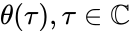 ,Im Failed to parse (MathML with SVG or PNG fallback (recommended for modern browsers and accessibility tools): Invalid response ("Math extension cannot connect to Restbase.") from server "https://wikimedia.org/api/rest_v1/":): {\displaystyle \tau > 0}
.
,Im Failed to parse (MathML with SVG or PNG fallback (recommended for modern browsers and accessibility tools): Invalid response ("Math extension cannot connect to Restbase.") from server "https://wikimedia.org/api/rest_v1/":): {\displaystyle \tau > 0}
.Examples
- BASETHETA(45) = 1.0177028497428964
- BASETHETA(90) = 2.0354056994857928
- BASETHETA(8640) = 0.6202026280698192
Related Videos
See Also
References